CBSE with a Waldorf-Inspired Approach: What It Means for Your Child
One says your child needs a strong, recognised academic foundation. The other says childhood should involve hands, curiosity, movement and real experience, not just notebooks. Most school brochures make you pick a side.
You don’t have to. CBSE decides what your child learns. A Waldorf-inspired approach shapes how your child learns it. They work at different levels, which is why a school can combine them.
This guide explains what each term means, how they fit together, what the trade-offs are, and how to judge whether this kind of school suits your child, at GRIPS or anywhere else.
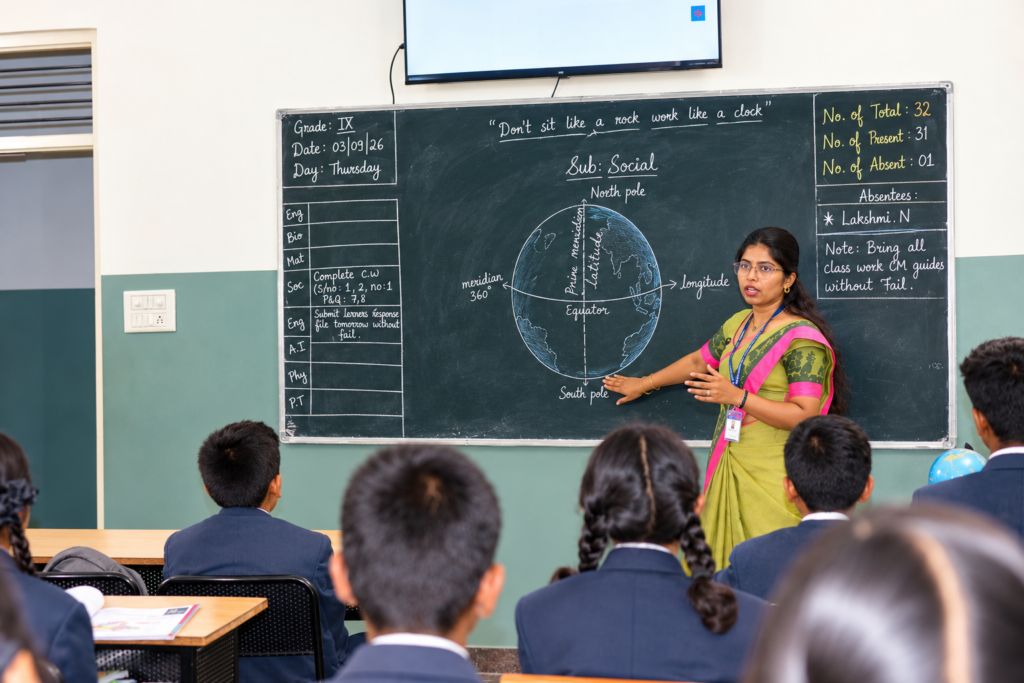
A curriculum is the syllabus and assessment framework: the subjects, topics and exams a child works through. A teaching approach is the method a teacher uses to bring that syllabus to life. Two schools can follow the same curriculum and feel completely different in the classroom.
Think of a curriculum as the destination and the teaching approach as the route.
| Dimension | Curriculum (e.g. CBSE) | Teaching Approach (e.g. Waldorf-Inspired) |
|---|---|---|
| Answers the question | What will my child learn and be assessed on? | How will my child experience learning? |
| Set by | A national board (e.g. CBSE) | The school and its teachers |
| Covers | Subjects, topics, assessment pattern | Classroom methods, pace, activities, environment |
| Example | Class-wise CBSE syllabus | Learning through observation, movement, creativity and practical work |
| Can be combined? | Yes, one curriculum can be taught through many approaches | Yes, can bring the curriculum to life |
CBSE (the Central Board of Secondary Education) is a national education board in India. Its curriculum sets the subjects, syllabus and assessment framework that affiliated schools follow, and its Class 10 and Class 12 board examinations are recognised across the country.
For parents, CBSE offers a common national framework (relocation mobility), clearly defined syllabus, and recognised board examinations. CBSE tells a school what to teach; it does not dictate how to teach it.
Waldorf education is a teaching philosophy developed by Rudolf Steiner in the early 20th century (1919, Stuttgart). It aims to develop the whole child thinking, feeling and doing through arts, practical work, movement and hands-on experience alongside academic study.
| Capacity | What It Means | What It Looks Like in Practice |
|---|---|---|
| Head | Knowledge and thinking | Concepts, reasoning, curiosity, academic understanding |
| Heart | Emotional and social development | Empathy, cooperation, self-awareness, healthy relationships |
| Hand | Practical work, creativity & experience | Making, building, gardening, art, movement |
At GRIPS, the Pre-Primary years use a Waldorf-inspired approach, and from Grade 1 to Grade 10 students follow the CBSE syllabus. Students are regularly assessed, and teachers monitor both class-level and individual progress.
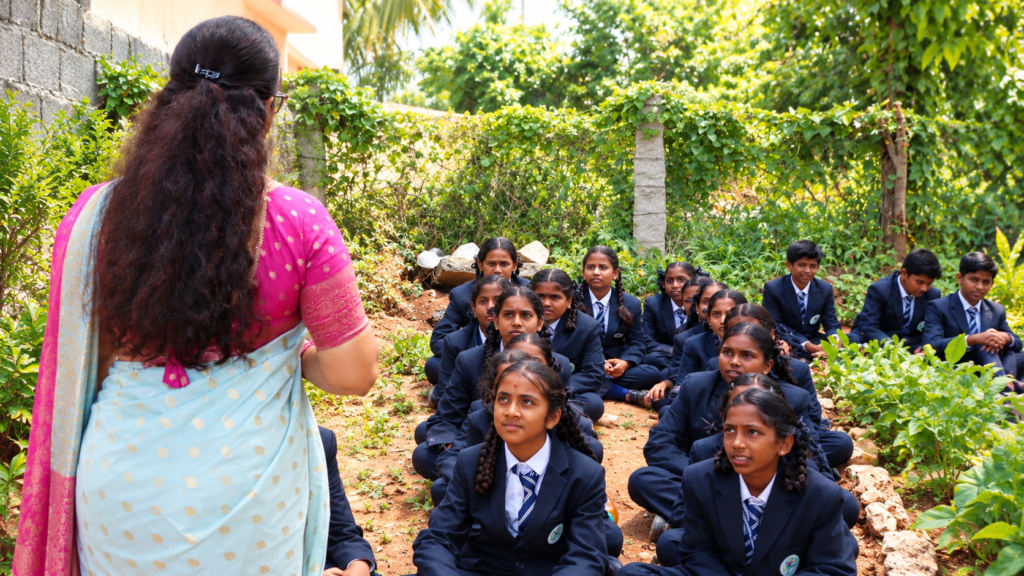
A green 2-acre campus in Dodderi, Tavarekere provides outdoor and play activities. Agriculture and farming-based activities are planned to help children work with their hands.
| Topic (CBSE Syllabus) | Conventional Delivery | Experiential Delivery (Illustrative) |
|---|---|---|
| Plants and growth | Read chapter, label diagram | Grow something, observe over weeks, then study the chapter |
| Measurement & fractions | Worked textbook examples | Measure real things: a garden bed, ingredients, materials |
| Where food comes from | A paragraph on agriculture | Take part in farming activity, then discuss what was observed |
| Community & cooperation | A social science chapter | A shared project where children have to work together |
Will my child be prepared for board exams? Direct answer: GRIPS follows the CBSE syllabus from Grade 1 to 10, so curriculum and assessments are identical to any CBSE school. Teachers monitor individual progress. Rigour comes from deep thinking, not mere memorization.
For parents, CBSE offers a common national framework (relocation mobility), clearly defined syllabus, and recognised board examinations. CBSE tells a school what to teach; it does not dictate how to teach it.
Follows CBSE from Grade 1 to 10; mandatory public disclosures on file.
Balances Head, Heart and Hand; applied in Pre-Primary.
No, separate origins and methods, both child-centred.
Call +91 94821 74498 / +91 84311 37115 or email gripsbengaluru@gmail.com
Copyright © 2026. Brand Swift